
Nadia Calviño – The spanish visionary
Nadia Calviño steered Spain through some of the most challenging economic crises in recent history, while proving that progressive policies and economic growth can go hand in hand. Who is she and ho did she achieve that?
3/9/20254 min read
A Visionary at the Helm
Nadia Calviño Santamaría, born in 1968 in A Coruña, Spain, built a distinguished career in European economic governance before becoming Spain’s Minister of Economy in 2018. She studied economics and law at the Complutense University of Madrid, later joining Spain’s Ministry of Economy in the 1990s. Her expertise led her to Brussels, where she spent over a decade at the European Commission, holding key positions in economic and financial policy. By 2014, she was appointed Director-General for Budget, overseeing the EU’s multi-annual financial framework. This experience equipped her with deep knowledge of European fiscal policy, crisis management, and regulatory affairs, making her an ideal choice to navigate Spain’s economic challenges in the post-crisis era.
When Nadia Calviño took over as Spain’s Minister of Economy in June 2018, the country was still navigating the aftermath of the financial crisis. Public debt stood at over 97% of GDP, and the deficit was at 2.5%. Tasked with balancing Pedro Sánchez’s progressive government with technical credibility, she brought with her a wealth of experience. Unlike her predecessors, who often adhered to political cycles, Calviño operated as a technocrat, bringing a disciplined yet socially conscious approach to economic governance.
Steering Spain Through Unprecedented Challenges
Her tenure coincided with some of the most tumultuous economic periods in recent history. The COVID-19 pandemic sent Spain’s GDP plunging by 10.8% in 2020, yet under her leadership, the economy rebounded by 5.5% in 2021. Rather than resorting to austerity, Calviño implemented strategic interventions that mitigated the worst effects of the crisis.
One of her most effective policies was the introduction of flexible ERTE (Temporary Workforce Adjustment Plans), which preserved 3.5 million jobs while limiting the economic burden to 2.1% of GDP—lower than similar programs in Italy and France. Additionally, she spearheaded a €140 billion loan guarantee initiative for small and medium-sized enterprises (SMEs), ensuring financial stability with an impressively low default rate of 3.7%.
Despite the need for emergency spending, she remained committed to fiscal responsibility. By 2023, Spain’s deficit had been reduced from 11% (in 2020) to 4.8%, a target reached faster than Germany and France. To balance the books, she introduced temporary taxes on energy companies and banks, raising nearly €6 billion in additional revenue. What makes her leadership remarkable is that she not only maintained economic stability but did so while implementing progressive economic policies that actively reduced inequality and strengthened workers' rights.
Rewriting the Rules of Spain’s Economy
Calviño’s impact extended beyond crisis management. Determined to modernize Spain’s labor market, she pushed through a transformative reform in 2022 that strengthened collective bargaining, leading to a 58% increase in permanent contracts—the highest in the OECD. At the same time, she championed a progressive wage policy, raising the minimum wage by 47% to €1,080, with studies confirming that the hike did not negatively affect employment.
Her leadership demonstrated that economic growth and progressive policies do not have to be at odds. She proved that strong worker protections, higher wages, and active social policies could exist alongside robust economic expansion. This approach defied traditional economic orthodoxy, which often frames progressive policies as a barrier to growth. Instead, Calviño’s tenure showed that well-designed reforms could drive both social fairness and economic dynamism.
Recognizing the importance of the digital economy, she launched Spain Digital 2025, an ambitious initiative that funneled €15 billion into expanding rural connectivity and achieving 95% 5G coverage. Her push for innovation also resulted in the passage of Spain’s Startup Law, which attracted a record €4.2 billion in venture capital investment in 2022.
A Green Transition with Economic Potential
Spain’s position as a leader in renewable energy owes much to Calviño’s strategic vision. She championed the PERTE program, mobilizing €16.37 billion to develop green hydrogen, positioning Spain as Europe’s second-largest producer. Under her watch, the Climate Change Law introduced a CO2 tax, which in turn helped fund social programs such as the Minimum Vital Income (IMV).
Her economic diplomacy also played a crucial role in securing massive foreign investment, including Volkswagen’s €7 billion gigafactory in Valencia and Amazon Web Services’ €2.5 billion investment in Aragón’s data centers. By embedding climate policies into Spain’s economic framework, she demonstrated that sustainability and growth could be mutually reinforcing rather than contradictory.
The European Factor: Shaping Spain’s Place in the EU
Calviño’s influence extended beyond Spain’s borders. As President of the Eurogroup in 2020, she was instrumental in advocating for flexible fiscal rules to facilitate green investment, laying the groundwork for the Next Generation EU recovery fund. Her European credentials were further cemented with her appointment as President of the European Investment Bank (EIB) in 2024, where she now oversees €30 billion in annual funding for Spanish projects.
Under her leadership, Spain became a more attractive destination for foreign investment, climbing from 10th to 5th place in the EU rankings. This success reinforced the idea that progressive economic policies could strengthen a country’s standing in the global financial system rather than undermine it.
A Legacy of Pragmatism and Progress
What set Nadia Calviño apart was her ability to balance technocratic discipline with social equity. She combined rigorous economic planning—marked by daily consultations with the European Commission—with a commitment to reducing inequality. Under her watch, 40% of EU recovery funds were allocated to Spain’s most disadvantaged regions.
Her leadership style was defined by transparency and evidence-based decision-making. She pioneered real-time fiscal dashboards, ensuring public accountability and reducing bureaucratic inefficiencies. Furthermore, her policies were built to last. She institutionalized key initiatives such as the Digital Transformation Agency, which now oversees the allocation of EU funds via blockchain, and an independent Fiscal Council, a model that has since been adopted by Italy and Portugal.
Most importantly, she reshaped the political discourse around economic policy. Rather than viewing progressive economic policies as an obstacle to fiscal responsibility and competitiveness, she demonstrated that they could, in fact, be the foundation for sustainable growth. Her work serves as a blueprint for policymakers all around the world seeking to harmonize economic dynamism with social justice.
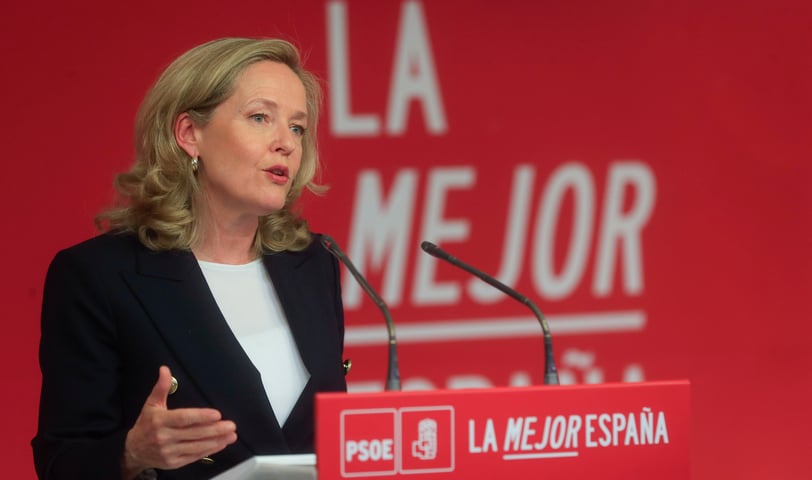
Nadia Calviño, during her SPEECH at the PSOE headquarters in Ferraz Fernando Alvarado EFE