
Mark Carney - The New Hope of Canada’s Liberal Party
As a world-renowned economist, Mark Carney brings experience and pragmatism to a Liberal Party in search of renewal. But with rising Conservative momentum and deep voter frustration, can he turn his economic vision into electoral success?
3/10/20256 min read
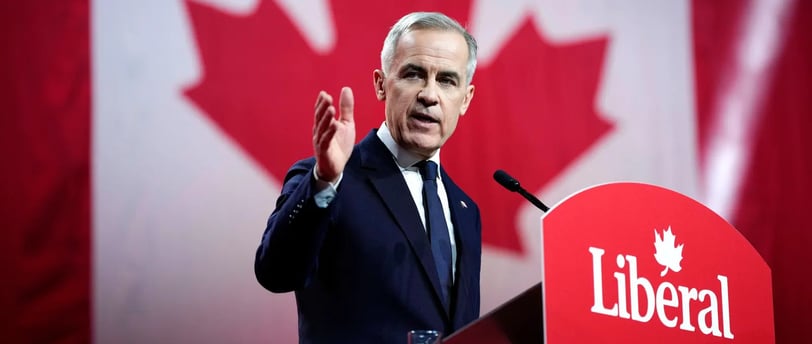
Liberal leadership Election
The election of Mark Carney as the new leader of Canada’s Liberal Party marks a significant shift in the country’s political and economic landscape. Securing an overwhelming 85% of delegate votes on March 9, 2025, the former central banker now prepares for a direct showdown with Conservative leader Pierre Poilievre in what is expected to be one of Canada’s most consequential elections in recent history.
Carney takes the helm at a moment of profound economic uncertainty. Canada is grappling with a worsening housing crisis, productivity stagnation, and trade tensions exacerbated by U.S. President Donald Trump’s protectionist threats. His leadership promises a blend of technocratic expertise and political pragmatism, positioning him as a stark contrast to Poilievre’s populist approach. However, with deep voter frustration over rising costs and economic instability, the real question is whether Carney can transform his financial acumen into a compelling political vision that resonates beyond his base.
From Central Banking to Political Leadership
Mark Carney's career trajectory is a study in global financial leadership. Born in 1965 in the Northwest Territories, he studied economics at Harvard before earning his doctorate at Oxford. His decade-long tenure at Goldman Sachs (1993–2003) deepened his understanding of global financial markets, but it was his appointment as Governor of the Bank of Canada in 2008, in the midst of the global financial crisis, that defined his public profile. Carney’s aggressive rate-cutting strategy—lowering interest rates from 4.5% to 0.25%—was credited with stabilizing Canada’s economy but also criticized for fueling long-term debt accumulation.
His international reputation grew when he became the first foreigner to lead the Bank of England (2013–2020), guiding Britain through the post-Brexit economic turmoil. Since 2019, Carney has been a UN Special Envoy for Climate Action and Finance, emphasizing his commitment to sustainable economic policies. Now, as the leader of the Liberal Party, he seeks to apply his economic expertise to political governance.
Economic Strategy: Between strong Investment and Fiscal Discipline
Carney’s economic platform is built on a five-pillar strategy that combines Keynesian-style public investment with a commitment to fiscal discipline. His core objective: transforming Canada into the “strongest economy in the G7.”
Fiscal Balance with Targeted Deficits
Carney promises to balance the federal operating budget by 2028, primarily through efficiency gains in public administration driven by AI. However, he also plans deficit spending on infrastructure, using a "productive debt" model where each public dollar is expected to generate five private investment dollars. While some economists, such as Philippe Gougeon (Appeco), question the feasibility of this timeline, Carney argues that strategic borrowing is necessary to modernize Canada’s economy.Tax Reforms to Support the Middle Class
His tax policy includes lowering income taxes for middle-class households while expanding the tax base by eliminating corporate tax breaks. Furthermore a signature proposal is the removal of the 5% Goods and Services Tax (GST) on first-time home purchases under CAD 1 million.Housing Construction Boom
Canada’s housing crisis is at the center of Carney’s platform. He pledges to double home construction to 400,000 units per year, targeting 4 million new homes over a decade. His plan includes promoting prefabricated housing, streamlining construction permits with AI, and expanding vocational training for construction workers.Energy Transition and Resource Sovereignty
Carney positions Canada as a "Clean Energy Superpower," advocating for increased investment in nuclear energy, hydrogen technology, and carbon capture. At the same time, he acknowledges the short-term necessity of maintaining oil and gas production as a "bridge technology." His plan also includes stricter export controls on critical minerals like lithium and rare earth metals to strengthen Canada’s industrial base.Productivity and Technological Innovation
A key goal is raising Canada’s annual productivity growth from 0.8% to 2.5% by integrating AI across key industries, including healthcare, education, and construction. This approach aligns with Carney’s broader strategy of ensuring Canada remains competitive in an increasingly digitized global economy.
Breaking with the Trudeau Era—Or Not?
Despite his deep ties to the Liberal establishment—having advised Prime Minister Justin Trudeau since 2020—Carney is keen to differentiate himself from the previous government. He describes the Trudeau years as a "decade of failure" in productivity, housing, and trade diversification. His critiques focus mainly on the soaring public spending (Under Trudeau, the state’s share of GDP increased from 14.2% (2015) to 19.8% (2024), a shift Carney sees as unsustainable), the regulatory overreach (Since 2015 4,200 new federal regulations have added CAD 12.3 billion in compliance costs for businesses), aswell as the extremely rising living costs.
Carney’s effort to distinguish himself from Justin Trudeau is crucial given the outgoing prime minister’s declining popularity. After nearly a decade in power, Trudeau faces voter fatigue, criticism and frustration over economic mismanagement, even in his own party. By framing his leadership as a break from the “lost decade” of sluggish productivity and housing failures, Carney positions himself as a fresh yet experienced alternative—offering continuity in liberal values while addressing the economic shortcomings that have weakened the party’s support.
However, Carney also maintains continuity with some key Liberal policies. He defends the carbon tax—originally designed during his tenure at the Bank of Canada—while proposing a border adjustment mechanism to protect domestic industries. He also supports the national dental and pharmacare programs introduced under the Liberals but promises to improve efficiency. His immigration policy, while critical of Trudeau’s handling of mass immigration, keeps a high intake level but ties it more directly to housing and labor market needs.
Facing Trump’s Trade War Threats
Mark Carney faces a major challenge in managing Canada’s trade relations with the U.S. under Donald Trump’s renewed protectionism. To counter potential 25% tariffs on key exports, he plans to maintain retaliatory tariffs on American steel, dairy, and electric vehicles until “respectful relations” are restored.
Seeking to reduce Canada’s dependence on the U.S., Carney is pushing for expanded trade with ASEAN nations and the EU through a fast-tracked CETA implementation. At the same time, he advocates stricter export controls on critical minerals like lithium to protect Canada’s tech and clean energy sectors. Additionally, he wants to link trade policy to national security by increasing domestic defense procurement from 20% to 80%, aligning with NATO’s 2% GDP defense commitment while boosting Canadian manufacturing. Carney’s strategy seems to be a careful balancing act: resisting U.S. pressure without triggering a full-blown economic standoff.
Carney vs. Polievre
Pierre Poilievre and the Conservative Party have launched relentless attacks against Mark Carney, attempting to brand him as "Trudeau in a better suit." Yet, this comparison falls apart under scrutiny. Unlike Trudeau, Carney is a world-renowned economist with a proven track record of steering economies through crises, from the 2008 financial meltdown to the post-Brexit turmoil in the UK. His leadership represents a break from the political status quo—bringing financial expertise, economic pragmatism, and a results-driven approach at a time when Canada needs it most.
Conservatives blame Carney for the surge in national debt, higher taxes, and increased regulatory costs, but the reality is more complex. The economic challenges Canada faces today—housing unaffordability, productivity stagnation, and trade dependency—are the result of long-term structural issues that no government alone has created. Carney, unlike his opponents, actually has the tools and experience to address these problems. His plan to balance fiscal responsibility with targeted investments is a stark contrast to Poilievre’s vague populist rhetoric, which offers simplistic solutions to complex problems.
However, Poilievre remains a strong opponent. His messaging has resonated deeply with voters frustrated by the rising cost of living, and his ability to connect with rural and working-class Canadians could be a decisive factor. Additionally, his Francophone heritage gives him a natural advantage in Quebec, a province where Carney, lacks deep cultural and political roots. The election will be a battle not just of policies but of political instincts—between Carney’s expertise-driven approach and Poilievre’s ability to channel voter frustration into a powerful electoral movement.
Far from being a liability, Carney's leadership is already reinvigorating the Liberal Party. Recent polls show a surge in support, with the Liberals leading 34% to 31% over the Conservatives in a Léger poll (March 2025) and 42% of Canadians preferring Carney as Prime Minister compared to 38% for Poilievre in an Ipsos survey.
Carney’s biggest challenge is overcoming the political cynicism that Poilievre has fueled—particularly in rural areas where anti-elite sentiment runs deep. But the election will come down to a fundamental choice: a leader with the global expertise to navigate economic storms or a career politician peddling anger without solutions. Crucially, as Liberal leader, Carney will immediately assume the role of Prime Minister, giving him a rare opportunity to demonstrate his economic vision in action before Canadians head to the polls. The coming weeks and months will serve as his proving ground—whether he can stabilize inflation, accelerate housing construction, and assert Canada’s position in global trade will directly impact his electoral chances. If he delivers early results, Carney’s transition from technocrat to political heavyweight could reshape the entire election dynamic, making him the clear frontrunner to lead Canada into a more prosperous future.
Mark carney holds a speech after wining the Liberal Leadership-Election imago